
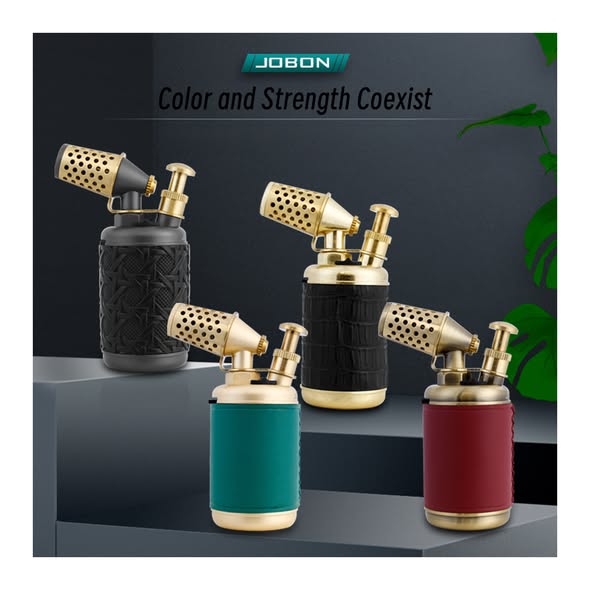
A jet torch lighter ignites pressurized butane into a concentrated blue flame. A regular lighter uses a wick and liquid fuel, or a simple gas valve, to produce a softer yellow flame. Picture yourself trying to light a cigar on a breezy patio. Your match dies before the tobacco catches. Now imagine a candle wick refusing to stay lit near an open window. The right lighter solves both problems.
The core difference comes down to fuel pressure, flame structure, heat output, and wind resistance. You need a clear, practical comparison to choose wisely. This guide delivers that. You will see exactly how each type works and where each one shines.
Key Takeaways
A jet torch lighter burns butane at high pressure to make a hot, blue flame.
A regular lighter uses low pressure and makes a softer, yellow flame.
Jet torch lighters resist wind and work well for cigars and camping.
Regular lighters are better for candles and indoor use.
Choose the right lighter for your task to get the best results.
What Is a Jet Torch Lighter?
A jet torch lighter is a high-intensity, wind-resistant lighter that produces little or no visible flame. You may also hear it called a micro torch, a torch lighter, or a jet turbo lighter. These devices belong to a broader category called multi-purpose lighters. That category also includes utility lighters longer than four inches for fireplaces and grills, plus portable soldering torches with self-contained fuel.
Under this definition, a lighter may be refillable or non-refillable, utilize a flint or electronic ignition system, and may be constructed under any style or design meeting the standards. This definition includes “cigarette” lighters and multi-purpose lighters. A multi-purpose lighter is one that is: (1) A utility lighter, that is, a lighter greater than four inches in length that may be used to light a fireplace or grill; (2) a micro torch or torch lighter or jet turbo lighter, that is, a high-intensity wind-resistant or wind-proof style that has little or no visible flame that may or may not be operated in a hands-free mode; and (3) a portable soldering or brazing torch with self-contained fuel supply.
A Concentrated Blue Flame
The flame color tells you a lot about what happens inside the lighter. A torch lighter supplies enough oxygen for complete combustion of butane. That complete burn creates enough energy to excite and ionize gas molecules, and the result is a blue flame. A yellow or red flame would signal incomplete combustion instead. In that case, insufficient oxygen leaves fine soot particles that glow by incandescence.
Combustion type | Flame color | Cause |
|---|---|---|
Complete combustion of butane | Blue | Sufficient oxygen; complete combustion creates enough energy to excite and ionize gas molecules. |
Incomplete combustion | Yellow/red | Insufficient oxygen; fine soot particles glow by incandescence. |
Why It’s Called a Torch Lighter
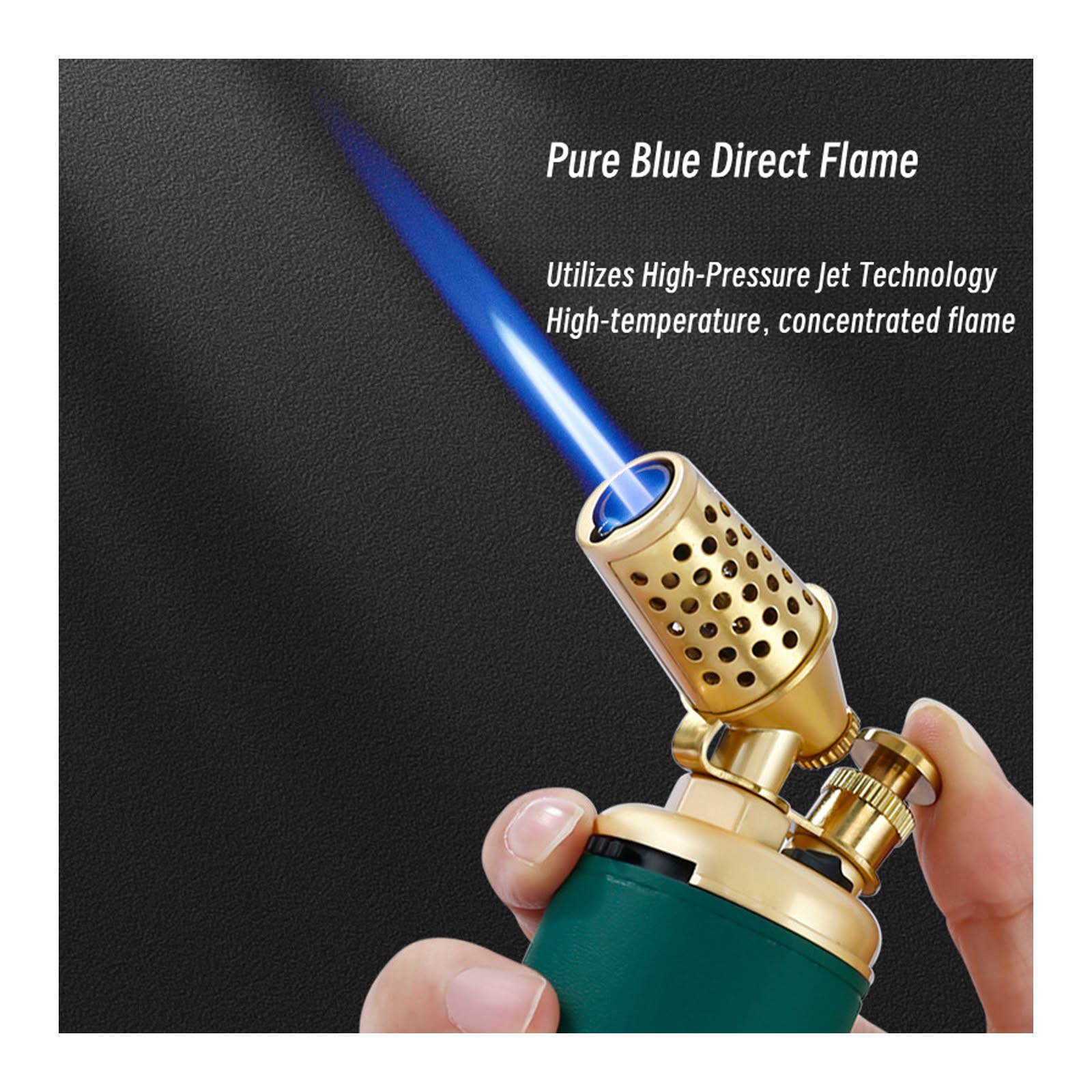
The name comes from the flame shape and behavior. A torch lighter forces gas through a narrow nozzle at high pressure. That pressure concentrates the flame into a tight, pencil-like stream. The stream burns hot and holds its shape even in moving air.
A regular lighter releases gas at low pressure. Its flame spreads out, flickers, and dies in a breeze. The torch design mimics an industrial torch on a small scale. You get a focused, powerful flame from a handheld tool.
How a Jet Torch Lighter Works
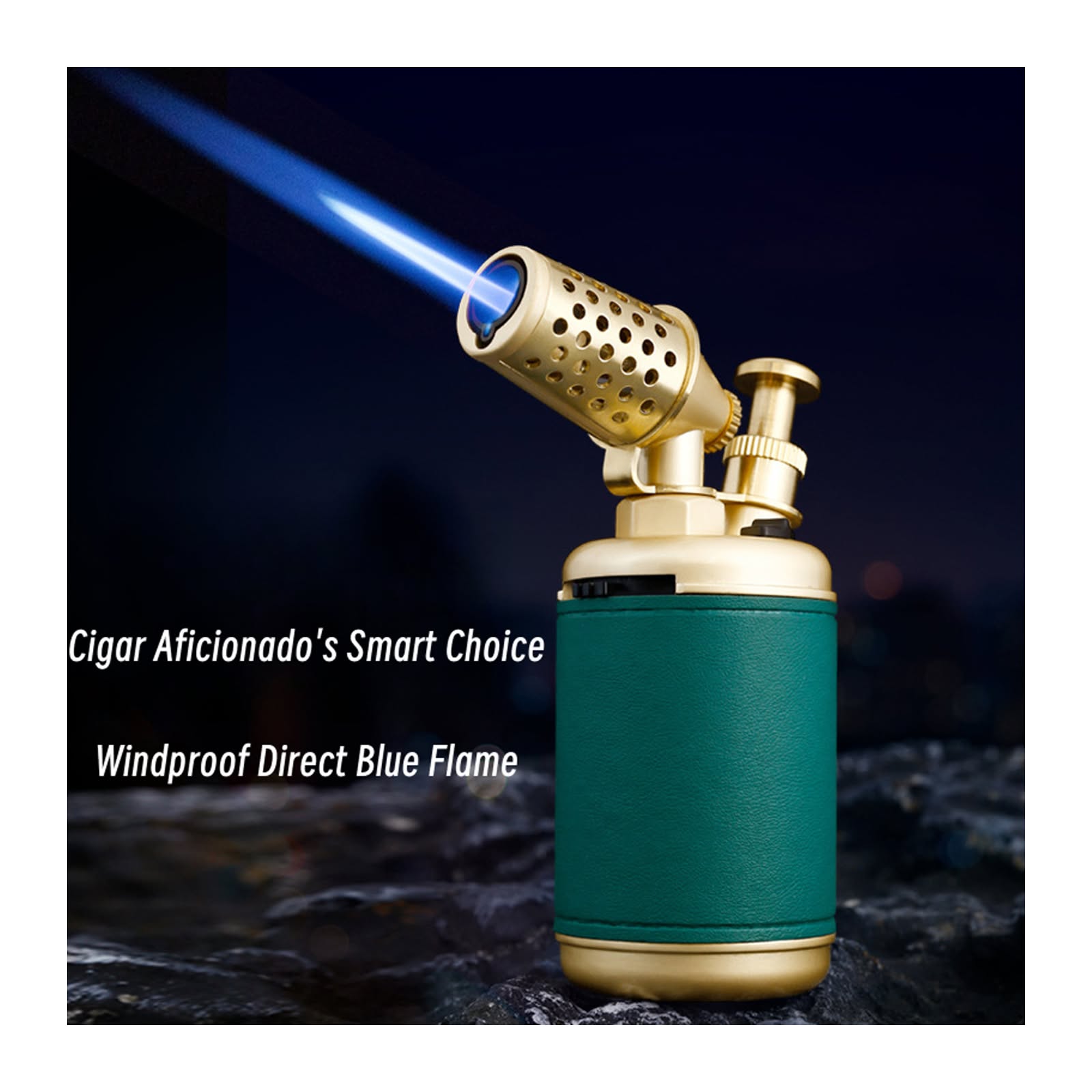
Butane powers your Jet Torch Lighter. You store this fuel as a liquid under pressure inside a small tank. Press the ignition button. The butane becomes gas and flows outward. The gas passes through a precise nozzle. It mixes with air. A spark ignites the mixture. You get a concentrated blue flame.
Pressurized Butane and the Nozzle
Follow the fuel’s journey:
Fuel Tank — Butane rests as a liquid under pressure inside a small tank. Activation releases the fuel in gas form.
Fuel Valve — This valve controls the butane release. Pressing the ignition button or lever opens it. Gas flows from the tank toward the nozzle.
Ignition System — Most jet lighters use a piezoelectric system. It generates a spark to ignite the released butane.
Flame Nozzle — The ignited high-pressure gas exits through a narrow, concentrated nozzle. You get a focused, wind-resistant jet flame.
Adjustment Mechanism — A dial or screw regulates butane flow. You control flame size and intensity.
The nozzle plays a starring role. It is very small and precise. Dust, lint, or carbon buildup can disrupt fuel flow. That buildup causes flickering or sputtering. Keep the nozzle clean for reliable performance.
The nozzle also enables the Venturi effect. This effect pre-mixes butane with an optimal amount of air before ignition. The optimal air-fuel ratio and rapid gas expulsion enable complete combustion. Complete combustion releases more energy as heat. The flame can exceed 2,000°F (1,100°C). A regular lighter’s yellow flame burns much cooler.
Air, fuel, and pressure must balance. Too much air or too little fuel disrupts the flame. Inconsistent pressure does the same. The torch effect appears from gas escaping under pressure. It burns in a concentrated stream, not a soft, candle-like flame.
Piezo Ignition and the Blue Flame
Your Jet Torch Lighter does not need a battery or flint. It uses a piezo ignition system. Pressing a button starts a mechanical chain:
A button compresses a spring-loaded hammer.
The hammer strikes a piezoelectric crystal, commonly made of lead zirconate titanate (PZT).
The sudden mechanical deformation produces a high-voltage electrical charge.
This high voltage creates a spark.
The spark ignites the butane flowing from the lighter.
No battery or external connection is required. Wires may carry the spark to the ignition point.
This design makes the lighter reliable and maintenance-free. You press, you get a spark, you get flame. That is the full cycle.
Complete combustion creates the blue flame. Enough oxygen reaches the butane. The complete burn excites and ionizes gas molecules. You see blue. A yellow flame would mean incomplete combustion and soot particles.
This high-pressure flame burns hotter and more consistently. It resists wind far better than a regular lighter flame. The pre-mixed gas leaves at high velocity. Outside air cannot push it around easily. You get a steady, pencil-like flame that holds its shape.
Butane is the most common fuel for both torch and regular lighters. The difference lies in pressure and mixing. Your torch lighter forces that same fuel through a narrow jet. It adds the right amount of air beforehand. That is how you get a small, powerful tool in your pocket.
How a Regular Lighter Works
A regular lighter produces a soft flame through a simpler path. It does not force fuel through a narrow nozzle at high pressure. Instead, it releases fuel at low pressure and lets it burn in open air. This design gives you a gentle, candle-like flame. Two main types dominate the market: wick lighters and disposable gas lighters.
Wick Lighters and Liquid Fuel
A wick lighter, such as the classic Zippo-style design, burns liquid lighter fluid (naphtha) instead of butane. The fuel tank holds absorbent wadding. This wadding interweaves with the lower part of the wick. The wadding keeps the wick saturated at all times.
Capillary action then draws fuel upward through the wick. Here is how the fuel reaches the flame:
The fuel tank is packed with absorbent wadding, which is interwoven with the lower part of the wick to hold fuel and keep the wick saturated.
Keeping the wick saturated allows capillary action to draw fuel from the reservoir toward the top of the wick, where it can be ignited.
Wadding must be distributed evenly with the wick down to the bottom of the tank; this ensures steady fuel flow to the flame, while poor wadding can cause weak performance or failure to light.
A flint spark wheel lights the soaked wick. The fuel then burns from the open wick. This open-wick design produces a steady soft yellow flame. The flame is wind-resistant in a classic sense, but it is not windproof.
Disposable Gas Lighters and Yellow Flames
Disposable gas lighters use butane, just like torch lighters. The similarity ends there. A disposable lighter releases butane at low pressure through a simple valve. The gas mixes with air in an open chamber. A flint spark or piezo spark ignites the mixture.
The low-pressure release and open mixing chamber produce incomplete combustion. Insufficient oxygen leaves fine soot particles that glow by incandescence. You see a yellow flame instead of a blue one. The table below summarizes the key differences between a wick lighter and a jet torch lighter.
Feature | Wick lighter (Zippo-style) | Jet torch lighter |
|---|---|---|
Fuel | Cotton wick soaked in liquid lighter fluid (naphtha) | Pressurized butane |
Flame appearance | Steady soft yellow flame | Focused, roaring blue jet flame |
Ignition/delivery | Flint spark wheel lights the soaked wick; the fuel burns from the open wick | Butane is forced through a tiny nozzle to create a concentrated jet |
Practical effect | Wind-resistant classic flame | Windproof hot concentrated flame |
A disposable gas lighter gives you a softer, cooler flame than a torch. It works well for candles and everyday indoor tasks. It struggles in wind and cannot deliver intense heat.
Key Differences Between Torch and Regular Lighters
Heat and Wind Resistance
Heat output separates these two tools more than any other factor. A jet torch lighter burns butane in a pre-mixed blue flame. That flame reaches 1,300–1,600°C (2,372–2,912°F). A standard butane lighter reaches roughly 1,970°C (3,578°F) at its peak. The higher peak number may surprise you. The torch still wins on practical heat delivery. Its blue premixed flame burns more efficiently. It transfers energy into the target instead of wasting it into the surrounding air.
Lighter Type | Fuel | Max Flame Temp (°C) | Max Flame Temp (°F) |
|---|---|---|---|
Torch / Jet Lighter | Butane (pressurized) | 1,300–1,600 | 2,372–2,912 |
Standard Butane Lighter | Butane (C₄H₁₀) | ~1,970 | ~3,578 |
Wind resistance tells a similar story. A regular lighter releases gas at low pressure. A breeze pushes the soft yellow flame sideways. The flame flickers, cools, and often dies. A torch lighter forces pre-mixed gas through a narrow nozzle at high velocity. Outside air cannot easily disrupt that stream. The flame holds its pencil shape and keeps burning. You can light a cigar on a windy patio without cupping your hand around the flame.
Fuel, Refillability, Adjustability, and Safety
Both lighter types commonly run on butane. The difference lies in how you handle that fuel. Most jet torch lighters are refillable. You buy butane fuel cans and refill the tank through a valve. The process follows a few simple rules. Let the lighter cool before refilling. Use the correct valve fittings or adapters. Do not overfill the tank. Wait for the fuel to settle before you ignite it.
Adjustability gives torch lighters another edge. A dial or screw regulates butane flow. You control flame size and intensity. Turn it down for spot lighting. Turn it up for intense heat. A disposable lighter offers no such control. Its flame size stays fixed until the fuel runs out.
Safety deserves your full attention. Child-resistant mechanisms are a mandatory requirement for multipurpose lighters under CPSC standards. The July 16, 2026 CPSC recall of certain Jobon butane torch lighters happened because those models lacked the required child-resistant mechanisms. If a model has an ignition lock, use it when you store the lighter. Keep any lighter away from heat and ignition sources. Refill in a ventilated area. Check for leaks after every refill. Use the lowest practical flame setting for the job at hand.
A wick lighter adds its own maintenance burden. You must keep the wadding saturated and the wick trimmed. A torch lighter asks less of you day to day. It rewards you with consistent performance and a flame you can trust in rough conditions.
Which One Should You Choose?
Cigars, Camping, and Outdoor Tasks
A jet torch lighter wins for cigars, camping, and any job that demands intense heat or wind resistance. Cigar Aficionado’s outdoor-smoking guide recommends a torch for open-air smoking. It notes that soft-flame lighters and matches fail in even a light wind. The La Aurora accessory guide agrees. A torch flame stays concentrated and powerful outdoors because moving air disturbs it far less.
Nozzle count matters for cigars. A single-jet torch aims all its heat at one narrow point. That design works well for spot lighting. A triple-jet torch spreads flame across a wider span. This wider spread helps you develop an even cherry on a larger cigar. A double-jet model sits between the two, distributing heat across two sources instead of one.
Camping and survival tasks reward the same strengths. A torch flame produces a strong, steady fire for diverse lighting jobs. A windproof design holds up in wind or rain. A refillable butane tank with a larger capacity supports extended trips. Look for an ergonomic grip and a slip-guard finish. These features help when your hands are cold, wet, or shaking. Store the lighter away from extreme heat and rotate your stock every 6–12 months.
Candles and Everyday Indoor Use
A regular lighter serves candles and everyday indoor tasks better. Its softer, cooler flame will not splatter wax or spill it. A torch flame burns too strong for this job. The same logic applies to cigarettes and joints. A torch can create a hot spot instead of a smooth, even burn.
General indoor use favors the simple disposable lighter. Torch models are built for specific tasks, not daily indoor work. They also pose a greater risk around paper and other flammable materials. One safety note deserves attention: refillable butane lighters with adjustable flame height are safer than torches for general fire safety. Torches can flare unpredictably when debris blocks the nozzle.
Regular lighters are often slower for low-heat jobs. They stay simpler and cheaper for those same tasks. For a candle on a calm evening, that trade-off makes perfect sense.
A Jet Torch Lighter trades fuel efficiency and simplicity for heat and wind resistance. A regular lighter trades power for convenience. Your choice depends on where and how you plan to use it. A torch burns butane faster, especially at high settings. It delivers a hotter, concentrated flame that holds up outdoors. A regular lighter stretches fuel further and gives you a softer flame for calm indoor tasks.
Pick a torch for cigars, camping, and outdoor reliability. Pick a regular lighter for candles and everyday indoor use. Match the tool to the task, and you will get the results you want.
FAQ
Why does a jet torch lighter produce a blue flame instead of a yellow one?
A torch lighter mixes butane with the right amount of air before ignition. That mixture burns completely. Complete combustion excites and ionizes gas molecules, and you see blue. A regular lighter burns fuel with too little oxygen. Soot particles glow, and that glow looks yellow.
Do jet torch lighters and regular lighters use the same fuel?
Both types commonly run on butane. The difference sits in pressure and mixing, not in the fuel itself. A torch forces butane through a narrow nozzle at high velocity. A disposable lighter releases the same gas at low pressure through a simple valve. Wick lighters use liquid naphtha instead.
How hot does a jet torch lighter flame get?
A torch flame reaches roughly 1,300–1,600°C (2,372–2,912°F). A standard butane lighter peaks near 1,970°C (3,578°F). The torch still delivers more usable heat. Its pre-mixed blue flame burns efficiently and pushes energy into your target instead of the surrounding air.
Can I adjust the flame on a jet torch lighter?
Yes. Most torch models include a dial or screw that regulates butane flow. Turn it down for spot lighting. Turn it up when you need intense heat. A disposable lighter offers no such control. Its flame size stays fixed until the fuel runs out.
Which nozzle count works best for lighting a cigar?
A single-jet torch aims heat at one narrow point. That design suits spot lighting. A triple-jet torch spreads flame across a wider span. This wider spread helps you build an even cherry on a larger cigar. A double-jet model falls between the two.